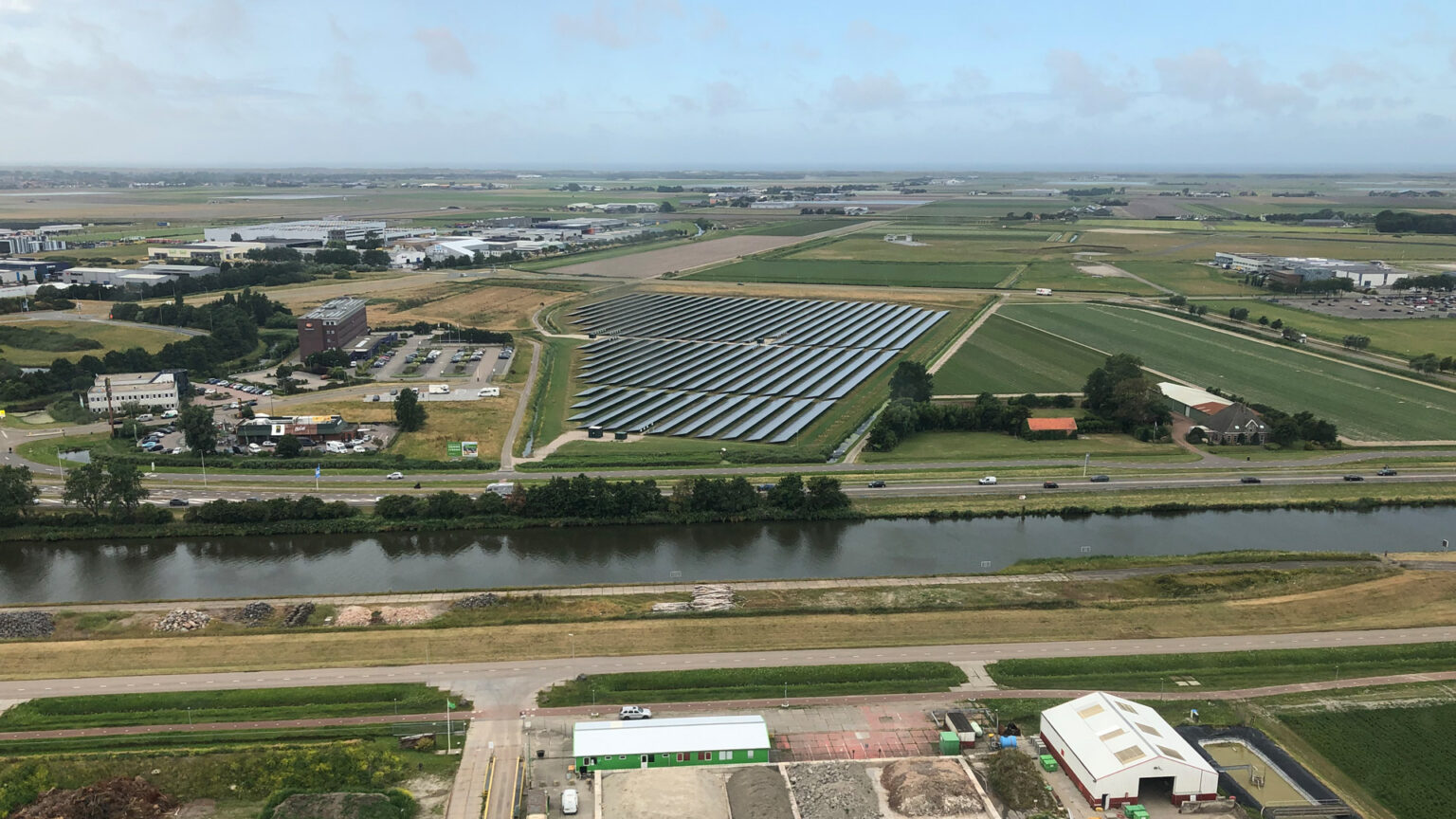

Solar park Heldair II was delivered in early 2026 as one of Ecorus’ own development projects. Located next to Den Helder Airport, the project is characterised by a combination of technical challenges, safety constraints and a wide range of stakeholders involved throughout the process.
There was a specific requirement for anti-glare panels and next to that, coordination with all involved parties required continuous alignment, with site activities closely monitored and regulated. As a result, design, permitting and execution developed in parallel, while decisions were being tested, adjusted and aligned throughout the project.
Total construction period
From the early stages of the project, the location introduced a level of complexity that influenced both planning and execution. Being situated next to Den Helder Airport, the site came with strict permit conditions and required formal approval before any construction activities could begin. Every deviation from the approved design had to be documented and aligned with both the municipality and the airport authorities.
The proximity to the airport also introduced specific technical requirements. The need for anti-glare panels so pilots would not be blinded, meant suitable components had to be sourced and validated beyond standard solutions. In addition, the presence of a high-pressure gas pipeline on site imposed strict safety conditions, influencing how and when certain construction activities could be carried out.
Alongside these location-driven challenges, a clear structure in both communication and processes was needed due to the number of stakeholders involved. Different parties, such as the municipality, water board and energy network operator, remained closely connected to the project throughout its execution, each with their own role in monitoring, approval and coordination. This made it necessary to organise responsibilities, align decision-making and ensure that information was shared and addressed in a consistent way.
One of the key decisions was how to deal with ongoing changes in panel selection during the engineering phase. While adjustments are common during early stages, changes at this point required the design to be revisited multiple times. Each option had to be assessed not only on technical performance, but also on its impact on the overall business case. To support this, multiple simulations were carried out to compare different scenarios and determine the most viable solution.
The construction approach was also adjusted to account for external uncertainties. Long lead times for the selected panels, combined with seasonal conditions such as high water levels in winter, required a different build sequence. Ground works and trenching were carried out earlier in the process, ahead of panel delivery. This approach enabled a rapid installation pace of around 3 MW per week once the panels arrived.
One of the key decisions was how to deal with ongoing changes in panel selection during the engineering phase. While adjustments are common during early stages, changes at this point required the design to be revisited multiple times. Each option had to be assessed not only on technical performance, but also on its impact on the overall business case. To support this, multiple simulations were carried out to compare different scenarios and determine the most viable solution.
The construction approach was also adjusted to account for external uncertainties. Long lead times for the selected panels, combined with seasonal conditions such as high water levels in winter, required a different build sequence. Ground works and trenching were carried out earlier in the process, ahead of panel delivery. This approach enabled a rapid installation pace of around 3 MW per week once the panels arrived.
It therefore does not come as a surprise that what stands out for Heldair II is not just the scale or the technical outcome, but how the project was executed across design, permitting and construction.
Despite the constraints of a tightly controlled environment, where safety requirements and site restrictions were part of the day-to-day execution, the full scope was completed as planned in early March 2026. The solar park, including 25,44 MW of installed capacity with 39.600 anti-glare panels and a nature-friendly landscape design, is a project that people genuinely enjoy talking about.
Before construction started, Heldair II went through a long-term development and financing process led by Ecorus. As the project developer, Ecorus managed stakeholder alignment, permitting, and financing, including securing a long-term Power Purchase Agreement (PPA) with Fastned that supported the project’s financial close.